JOURNAL SCHEDULE
Regular issues of BEMAN are published four times a year, according to the following schedule:
- Issue 1 - in March
- Issue 2 - in June
- Issue 3 - in September
- Issue 4 - in December
Special issues of BEMAN are published at most once a year. Accepted papers for the special issues are published on a continuous basis (as soon as accepted) and listed together on the special issue page of the journal.
MANUSCRIPT SUBMISSION
BEMAN welcomes submissions of applied and theoretical research papers in all fields of management. To be published in BEMAN, a manuscript must significantly advance theory and/or practice, provide managerially meaningful and generalizable empirical research, or provide new models or methods that can be used to improve management.
Manuscripts should be written in English, following the style specified in the Manuscript style section.
The manuscripts must be prepared electronically in Microsoft Word format and should be submitted by e-mail to the address: beman.journal@gmail.com or beman_journal@yahoo.com.
For the preparation of the manuscript a Word template should be used. To download the BEMAN template click here.
BEMAN strongly encourages authors to provide their ORCID iD(s) during submission. ORCID identifiers improve author identification, discoverability, and interoperability of scholarly metadata.
The submission of a manuscript for publication in the journal implies that it has not been published (except in the form of an abstract or as part of a published lecture, review, or thesis), nor is being considered for publication elsewhere.
The journal has NO article processing charges or submission charges, nor subscription or pay-per-view fees.
PEER REVIEW PROCESS
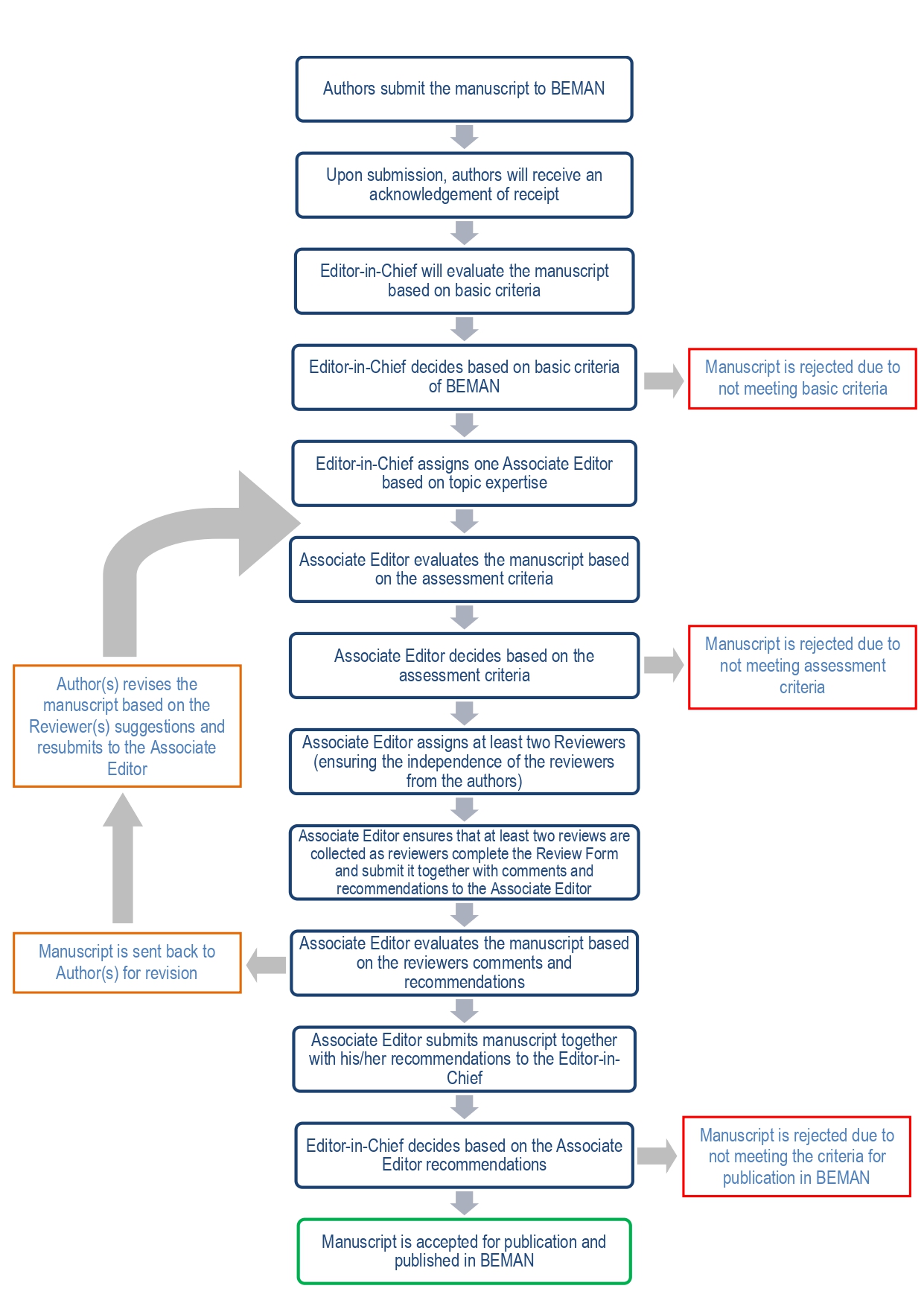
All papers submitted to a regular issue or to a special issue are handled under an independent peer review process. Special issues articles have the same editorial oversight as regular papers, including external peer review, and are clearly labeled. All submissions are processed through the same standardized editorial workflow, including fully traceable identical stages of submission, editorial screening, double-blind peer review, revision, and final decision, applied uniformly to both regular and special issues. The Editor-in-Chief is responsible for the content of the entire journal, including all special issues, which must fall within the scope of the journal.
Update of editorial metadata standards (effective June 2026): All articles published from June 2026 onward include standardized editorial history metadata (Received, Revised, Accepted, and Published online dates) to enhance transparency and consistency of the editorial process. Articles published prior to this date follow the metadata standards in place at the time of their publication.
Upon submission, all authors will receive an acknowledgement of receipt.
Following a brief editorial review to determinate the manuscript’s appropriateness for BEMAN, each manuscript will be blind reviewed by two independent, external reviewers. The review process will take approximately 2 months. The reviewers will evaluate the submitted papers - for both regular and special issues - against the following checkpoints:
- Relevance to BEMAN
- Originality
- Significance, usefulness
- Reference to the related literature
- Presentation
- Linguistic quality
The reviewers are expected to complete the review form.
At the end of the review process authors will be notified on the status of their manuscripts – accept, revise and submit, or reject – and will receive feedback from the reviewers. If the reviewers ask for revision of the article then the authors should make the revision and the article will be published after the reviewers' acceptance.
COPYRIGHT
Before publication, authors of accepted manuscripts must sign a Copyright Agreement Form, transferring copyright to BEMAN.
Authors are encouraged and allowed to use the Version of Record (the final published PDF) for non-commercial academic and educational purposes. Authors may deposit the Publisher’s PDF in institutional or subject repositories, personal websites, and academic social networks, without embargo (0 months), provided that full citation and a link (URL/DOI) to the original publication in the journal is included.
BEMAN publishes open access articles distributed under the terms and conditions of the Creative Commons Attribution License (https://creativecommons.org/licenses/by-nc/4.0/). The CC BY-NC License permits non-commercial use, distribution, and reproduction, provided the original work is properly cited.
This work is licensed under a Creative Commons Attribution-Non Commercial 4.0 International License. 